
“Pay careful attention to yourselves and to all the flock, in which the Holy Spirit has made you overseers, to care for the church of God, which he obtained with his own blood.” — Acts 20:28
Seasons of Care & Pastoral Care Guidelines
Frontline South Elders · Hub Leadership · Community Group Leadership
Purpose Statement
Frontline South is committed to building culture of purposeful, proactive and biblically grounded care for every person entrusted to us. This document serves as the official care ministry process---defining who leads care, what levels of care apply, and how specific seasons of life are handled with consistency and compassion.
SEASONS OF CARE SECTIONS:
FOUNDATIONS | CARE LEVELS & RESPONSIBILITIES | REPORTING CARE
ADDITIONAL Resources:
DETAILED CARE PLANS | RESOURCE LIBRARY
FOUNDATIONS
Defining Seasons of Care
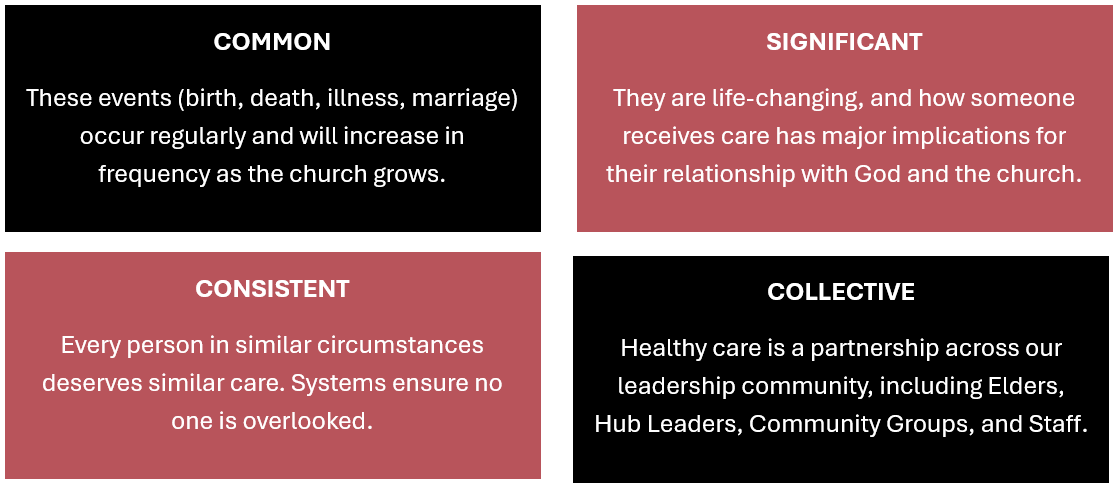
“Seasons of Care” refers to the common, significant life events that occur regularly within our congregation. What makes them distinct from other care needs is their frequency, their impact, and the need for a consistent, collective response. These seasons of care are marked by at least four main characteristics:
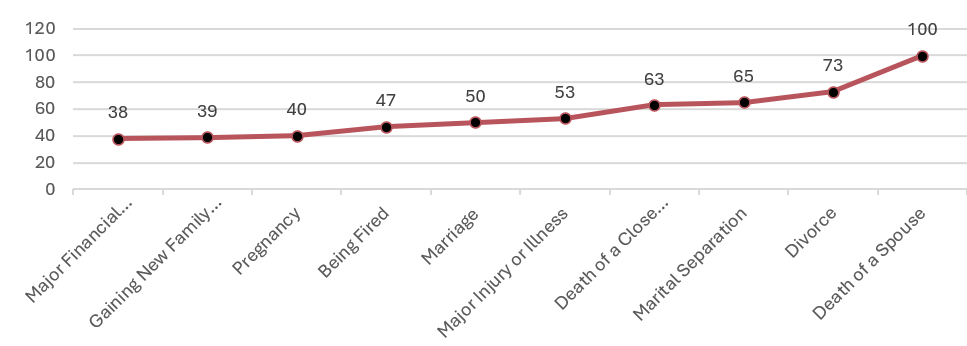
LIFE STRESS SCALE: Top Events in a Person's Life
OUR CORE VALUES IN CARE
As we care for people, the following values guide our methods and our hearts.
SPIRIT EMPOWERED
In Zechariah 4:6, the LORD reminds us that God’s will is not done by might or by power, but by His Spirit. We believe that any real, impactful ministry only happens by the influence and will of the Holy Spirit. Therefore, we will seek Him and invite Him into all our care efforts.
GROUNDED IN PRAYER
James tells us in 5:16 that the prayers of a righteous man avail much or truly make a difference. Therefore, the primary way that we will work to make our care ministry spirit empowered is through prioritizing and establishing effective prayer teams and support, lifting up both people and their needs.
GOSPEL CENTERED
Colossians 1 reminds us of the supremacy of Christ (1:18) and that everything the Father does is ultimately to honor His Son. All that we seek to do in caring for people must ultimately end by bringing glory to Jesus. Therefore, we must tenaciously fight for that cause and remain humble in our efforts, not wanting to take away anything from Him.
ACTION ORIENTED
First John 3:18 directs us to love in deed and action, not just word. Many times, in care situations, especially difficult ones, what to do is unclear or even intimidating. But when we are uncertain of what to do, we want to act rather than wait or be passive. Therefore, we will move intentionally toward people in love when they are in need and trust the Spirit for the outcome.
MEMBERS FIRST
Galatians 6:10 reminds us to prioritize the “household of faith” when doing good, and that would be true of care within the church as well. We have covenanted with our members to serve them and, therefore, when we have limited resources (people, time, money, etc.) and must choose whom to serve, we will prioritize our members first over the rest of the body and our local community.
NOTE: If you have any questions or need help thinking through a situation, please reach out to Tim Campbell or your Hub Leader.
CARE LEVELS & RESPONSIBILITIES
Frontline South uses three levels of care to ensure that every situation receives the right attention and the right team of people. Understanding which tier a situation falls into determines who leads care and how frequently follow-up occurs.
LEVEL ONE
Situations that fall under the “one another’s” in Scripture. These are not emergencies and can be handled within the group. However, these issues should still be communicated in the weekly Community Group Reports.
LEVEL TWO
Situations that require intentional care that stretch beyond the community group and community group leader’s margin. The hub leader will step in working alongside the community group leader to provide support and direction. These are situations that if left unattended could lead to elder-level care.
LEVEL THREE
Situations that require immediate, pastoral, and professional help at times. Elders will oversee and drive care in these situations.
LEVEL 1 — COMMUNITY GROUP LEADER CARE
Situations that need care but are not emergencies and can be handled from within a Community Group. These can be handled by Community Group Leadership, which will drive care while communicating through Community Group Reports and regular Hub Leader check-ins.
CARE WILL LOOK LIKE
Minimum Care at this Level Will Look Like:
Community Group (CG) Leaders will follow up as needed (during the normal rhythms of c-group and d-group) to ensure adequate attention and care.
The CG Leader can use their discretion on how much attention to give for each of these scenarios.
All updates are communicated via Care Group Reports and to Hub Leaders directly as needed.
TYPES OF CARE
Examples of CG Leader Care:
- Pregnancy
- Engagement / Weddings
- Occasional absence from church or Community Group
- Non-criminal, non-egregious sin issues
- New believer discipleship
- Minor illness and minor surgeries
- Minor marital and family conflict
LEVEL 2 — HUB LEADER CARE
Situations that require intentional care and special attention by both the Community Group Leader and the Hub leader. Hub Leaders drive care alongside Community Group Leadership and may involve an elder or professional help. If left unattended, these can easily become elder-level care.
CARE WILL LOOK LIKE
Minimum Care at this Level Will Look Like:
Hub Leaders will ensure that Tim Campbell is made aware of the situation so that the elders know. Utilize the Care Group Reports or email Tim Campbell.
Minimum follow-up: at least twice per month.
Hub Leaders maintain frequent communication with
Community Group Leadership.
TYPES OF CARE
Examples of Hub Leader Care:
- Birth, adoption, and fostering (If the situation requires intentional care outside of the normal rhythms)
- Miscarriage
- Significant or chronic marital and family problems
- Hospital admission and serious surgery
- Financial problems and benevolence
- Deployments
- Unemployment (with significant financial implications)
- Major disagreements with the church
- Crisis of faith
- Chronic absence from church or Community Group
- Some mental health issues
- Addictions (examples: pornography, substance abuse, gambling, behavioral)
LEVEL 3 — ELDER LEVEL CARE
Situations that require immediate, pastoral, and at times professional help. Elders drive care at this level in constant communication with Hub and Community Group Leadership. In some cases, referrals to outside professional help are required. If left unattended, these can lead to major physical, emotional, or spiritual harm.
CARE WILL LOOK LIKE
Minimum Care at this Level Will Look Like:
Elders lead and drive the appropriate plan for all Level Three situations.
Maintain consistent communication with Hub and Community Group Leaders.
Provide at least weekly follow-up, even when there are minimal updates.
When necessary, make referrals to outside professionals who are vetted, and theologically aligned.
Legal consent forms are required for all Frontline paid counseling.
The Director of Care will follow up weekly.
Tim Campbell will send a monthly elder care update report to Frontline South Elders.
TYPES OF CARE
Examples of Elder Leader Care:
- Major marital and family conflict
- Marital separation or divorce
- Serious medical diagnoses or major health crises
- Criminal behavior, including predatory or abusive actions
- Major legal issues
- Major disagreements with Frontline Church
- Physical or sexual abuse see note on how abuse is reported at the end of this document
- Adultery
- Crisis of faith or significant theological departure
- Suicidal ideation or behavior
- Severe mental health concerns (depression, anxiety, self-harm, psychotic disorders, formal diagnoses, PTSD)
- Death (acute grief situations requiring intensive care)
- Individuals leaving the church under difficult or concerning circumstances
REPORTING CARE
HOW TO REPORT CARE NEEDS
Reporting care accurately and promptly ensures no one falls through the cracks. Use the right channel for the right level of care:
Cg leaders
Level 1: Community Group Level Care: Use your weekly CG Report to communicate all level one care. Use your discretion to send a follow up text to your Hub Leader.
Level 2: Hub Leader:
Alongside your CG Report send a text or call your Hub Leader.
Level 3: Elder Level Care:
Call or text your Hub Leader/Elder the day of.
hub leaders
Whenever Community Group Leaders request Hub Leader involvement or a care need from a member exceeds the resources or capabilities of the Community Group, please fill out the Care Report Form as a default. The Director of Care will receive these reports and provide the necessary support.
All care needs must be communicated through the appropriate channels so that the people we are caring for get the support they need in their given season.
staff & elders
Staff will use the Care Report Form, while elders will use the Elder Update Form. Since work proximity allows for calls or in-person meetings with the director of care, these options are sufficient for both staff and elders, depending on the severity of the situation.
Members may also self-submit via:
‣ The Welcome Card (care needs checkbox on the back)
‣ Email: Tim Campbell
‣ Annual Membership Renewal Form
** All requests are processed by the Director of Care and documented appropriately.
examples:
Sample CG Report — Praise and Prayer Requests
“Jack and Jill shared that their marriage feels really challenging. They see things very differently and their arguments and fights have been pretty heated. They agreed that they need pastoral and potentially professional care. They’re ready to be connected to our hub leader.”
Sample Hub Leader Text
“Hey [HUB LEADER]—I just wanted you to be in the loop that Jack and Jill are having some significant marital conflict pretty regularly and are struggling in their marriage. We encouraged them and asked if we could relay it to our hub team for care and help, and they said yes. Let me know if you need any more information before reaching out to Jack and Jill.”
SAFETY & REPORTING
- Do NOT delay escalation in situations involving safety, abuse, or potential harm.
- People may be referred to counselors, mental health professionals, DHS, or the police as appropriate.
- Immediately involve Hub Leadership and Elders. Follow all reporting policies within our Child Protection & State Guidelines.
- When in doubt, err on the side of communication.
CARE REPORTS OVERVIEW
Director of Care, Tim Campbell, sends two types of regular updates to Frontline South Elders and Hub Leadership:
FRONTLINE SOUTH CARE REPORTS (ELDERS, HUB LEADERS, STAFF)
- Captures normal rhythms of shepherding and life events
- Not crisis-level—but important for awareness and prayer
- Concise summaries of meaningful updates from the week
- Highlights anything that may develop into a higher-level need
ELDER CARE UPDATE REPORT (ELDER-LEVEL ONLY)
- Situations requiring immediate, ongoing, intensive oversight
- Situations where risk of harm is significant or complexity is high
- Sent monthly to Frontline South Elders
- Includes coordination with outside professionals as needed
- Church discipline situations and status